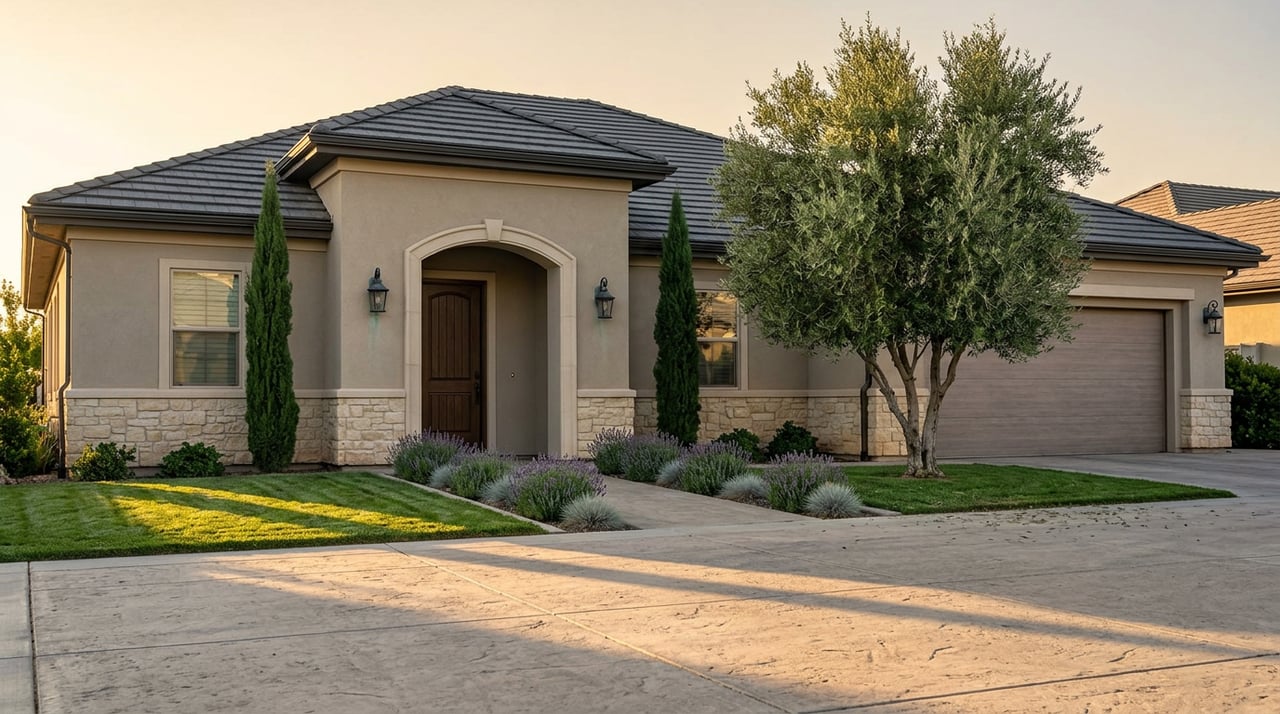
Drive through Shepherds Ranch in Visalia this month and you'll pass a D.R. Horton sign advertising a home priced like most new construction in the city this year, comfortably in the high $400s. Turn the corner onto an established street two blocks over and you'll find a resale listed $60,000 lower. On paper, the resale looks like the obvious move. Run the actual numbers a lender would run, and the two houses can land within a few dollars of each other on the monthly statement.
That gap is not a rounding error. It is the whole story of how new construction is priced across the Central Valley right now, and almost nobody explains it to buyers before they've already fallen for the sign in the yard.
The math builders don't want you doing with list price alone
New construction in Visalia averaged $485,000 in the first quarter of 2026, roughly $60,000 above the resale median of $425,000 for the same period. Builders held that gap open on purpose. What they didn't hold constant was the financing.
As of late August 2026, D.R. Horton is running a rate buydown across eleven Visalia-area communities, including Amber Ridge, Bella Oaks I and II, Daleglen, Greenwood, Jacobglen, Owenglen, Pratt Estates, Shepherds Ranch, Sutton Grove, and Victory Oaks. Home Stimulus, which tracks and grades published builder incentives, put the estimated total savings at $26,405, or about 6.4 percent of the home price, measured against a market-average 30-year rate of 6.483 percent as of August 20. The calculation assumes a $331,802 loan on a $414,753 starting price, which is close to the median for the communities the offer covers, and a seven-year holding period, which is roughly how long the average 30-year mortgage actually lasts before a sale or refinance.
The deal window matters too. It requires a contract on or after July 28 and a close by October 30, which means anyone shopping new construction in Visalia right now is inside the exact window this package covers.
The detail buyers skip past: a temporary buydown like a 2-1 or 3-2-1 is valued at its exact, finite total, but you still qualify for the loan at the full note rate, not the discounted one. That's an underwriting rule, not a sales pitch, and it changes what a buyer should actually ask for when comparing two offers.
Why the discount never touches the sign in the yard
Builders rarely cut the number on the sign. Doing so upsets the buyer who closed last month at full price, and it resets the comparable sale every remaining lot in that subdivision gets measured against. A rate buydown solves the same problem a different way: it lowers what the buyer pays every month without lowering what the builder can point to as the neighborhood's going rate.
This isn't new. Appraisers have watched builders play this game since long before rate buydowns became a headline feature. Inside an active subdivision, the builder is competing directly against every resale on the same streets, right up until the last lot sells out. Once the subdivision is fully built, that competitive pressure disappears and the market reverts to ordinary resale comps.
San Joaquin Valley Homes, the Visalia-based builder active in Hanford, Tulare, and across the region, publishes the mechanics plainly on its own site. Builder contributions cap at 6 percent of the purchase price, incentives are only available through the builder's preferred lender, and offers can't be stacked with anything else. A separate hometown hero program adds a bit more for active military, law enforcement, firefighters, teachers, and licensed medical staff. None of that is unique to one company. It is close to the industry standard, and it tells you the buydown-instead-of-price-cut approach is a structural habit across the Valley's builders, not a one-off marketing stunt at a single community.
Even the discount for closing costs varies by city, which is its own quiet signal about where builders feel the most competitive pressure. D.R. Horton's Lunaria community in Hanford currently offers up to $2,500 toward closing costs, while its other Central Valley communities cap the same program at $1,000. Hanford is where the builder is working harder to move buyers.
The appraisal rule that turns this into a seller's problem
Here's where the mechanism stops being a buyer curiosity and starts being a transaction risk for anyone who already owns resale next to one of these subdivisions.
Freddie Mac's Single-Family Seller/Servicer Guide lays out specific rules for appraising a home inside a new subdivision. The appraisal must include at least one comparable sale from inside the subdivision, which can be a sale by the builder itself, plus at least two comparable sales where the builder was not involved in the transaction. Resales inside the subdivision are preferred when they exist and are given significant weight as the most reliable indicator of value.
Read that closely and the friction becomes obvious. Early in a subdivision's life, before enough resales exist to lean on, an appraiser has little choice but to reference the builder's own incentivized sales, sales built on a full sticker price backed by a rate buydown the appraiser can't fully strip out of the number. A homeowner reselling on the street next door inherits a comp set shaped by a price that was never a clean market price to begin with. It was a monthly payment wearing a price tag.
That's the friction that shows up mid-transaction, after an offer is in hand, when the buyer's lender orders the appraisal and the number comes back tied to a builder sale nobody thought to question.
What the three cities are actually doing differently
The pace of new construction is not the same across Tulare County and Kings County, which changes how sharp this dynamic is depending on where you're looking.
Visalia issued 412 single-family building permits in 2025, a 6 percent drop from 2024, according to the Tulare County Building Department. Hanford's pace slowed further and faster. Building permits there fell from 176 in the first half of 2025 to 115 over the same six months of 2026, based on figures from the trade publication Construction Monitor reported by the Sun-Gazette. Tulare's resale market, meanwhile, was pricing at a median list of roughly $420,000 as of August 2026.
Put those together and Visalia is where the incentive-versus-comp dynamic is sharpest right now, simply because there are more active subdivisions and more named communities running live buydown programs. Hanford's slower building pace means fewer fresh builder comps are entering the resale pool, which is a small mercy for sellers there but not a permanent one. Tulare sits in between, with a resale price close enough to Visalia's new-construction incentives that shoppers cross-shopping both cities need to run the same monthly-cost comparison rather than trusting the list price alone.
Four questions worth asking before you compare a new build to a resale
- Is the rate buydown temporary or permanent? A temporary buydown fades after one to three years and the payment jumps back to the full note rate. A permanent buydown holds for the life of the loan and matters more if you plan to stay put.
- What's the APR, not just the advertised rate? The advertised number is the headline. The APR folds in the cost of buying that rate down and gives you the real comparison.
- Does the incentive require the builder's in-house lender? Most do. Get a quote from an outside lender anyway so you know what you'd be giving up to take the deal.
- What's the contribution cap? San Joaquin Valley Homes limits builder contributions to 6 percent of purchase price. Ask every builder you're considering for their equivalent number in writing before you assume two offers are actually comparable.
If you're selling next to one of these communities
If your resale sits near an active subdivision, the builder's incentive package is quietly setting the terms you're competing against, even though your closing costs and financing structure look nothing alike. A straight price cut on your end lowers your equity. A builder's rate buydown lowers the buyer's payment without touching either number on paper. Those are two different tools solving the same problem, and only one side controls both of them.
Price against the concession-adjusted comparison, not the sticker price down the street. If a buyer needs a lower payment to compete with what the builder is offering, a seller-funded rate buydown or closing cost credit can accomplish the same thing a price cut would, without the same hit to your bottom line.
FAQ
Is new construction actually cheaper than resale in the Central Valley right now? Not on the sticker price. Visalia's new construction averaged $485,000 in Q1 2026 against a $425,000 resale median. The gap narrows or disappears once a buyer factors in an active rate buydown, but it depends entirely on which incentive package is live and which lender you use.
Do I have to use the builder's lender to get the incentive? In most of the Central Valley packages, yes. Both D.R. Horton's advertised offers and San Joaquin Valley Homes' published terms tie the incentive to their preferred lender. Get an outside quote regardless, so you can see exactly what the incentive is worth against open-market financing.
Does a builder's rate buydown affect my home's appraised value if I already own resale nearby? It can, especially early in a new subdivision's life before enough independent resales exist. Freddie Mac's appraisal guidance allows builder sales to count as comps inside a new subdivision, which means the price a builder advertised, financing incentives and all, can end up shaping what your own home appraises for.
New construction and resale aren't really competing on price in the Central Valley right now. They're competing on who controls the financing, and right now that's the builders. If you're weighing a new build against a resale in Visalia, Tulare, or Hanford, or trying to price a resale next to an active subdivision, The Shawn Team can walk you through the concession-adjusted numbers before you sign anything.